

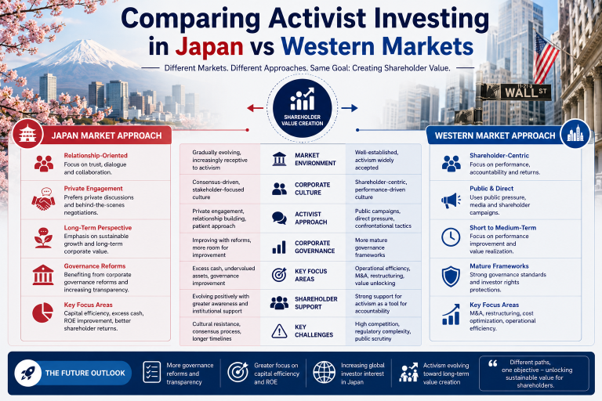
Activist investing has become an influential force in global financial markets, shaping corporate governance, capital allocation, and shareholder value creation. Activist investors typically acquire meaningful stakes in publicly traded companies and seek changes they believe will improve business performance and unlock value for shareholders. While the core objective remains similar across regions, the methods, reception, and outcomes of activist investing can vary significantly depending on market culture and regulatory environments.
In recent years, activist investing Japan has attracted increasing attention from global investors as corporate governance reforms and shareholder-focused initiatives have transformed the country’s investment landscape. What was once considered a challenging environment for shareholder activism is gradually becoming more receptive to investor engagement.
Many activist campaigns are built around a fundamental investment strategy, where investors identify undervalued businesses with strong underlying assets, operational potential, or inefficient capital structures. The goal is to create value through constructive changes rather than relying solely on short-term market movements.
What Is Activist Investing?
Activist investing involves investors taking ownership positions in companies and using their influence to encourage strategic, operational, or governance changes.
Common objectives include:
- Improving capital allocation
- Increasing shareholder returns
- Enhancing corporate governance
- Driving operational efficiency
- Encouraging strategic restructuring
- Unlocking hidden asset value
Activists may engage privately with management teams or publicly advocate for specific changes.
The success of activist investing often depends on the investor’s ability to persuade management, boards, and other shareholders that proposed changes will improve long-term value creation.
While activism is often associated with confrontation, many modern campaigns focus on collaboration and constructive engagement.
Historical Differences Between Japan and Western Markets
Historically, Japan and Western markets have approached shareholder activism very differently.
In the United States and parts of Europe, activist investing has been established for decades as a recognised component of corporate governance. Shareholders have generally been more willing to challenge management decisions and advocate for changes when performance falls short.
Japan, by contrast, traditionally emphasised:
- Stakeholder relationships
- Corporate stability
- Long-term employment
- Consensus-based decision-making
- Cross-shareholding structures
These characteristics often limited the influence of external shareholders and created barriers for activist investors seeking rapid change.
Corporate Governance Reforms in Japan
One of the primary reasons activism has gained momentum in Japan is the implementation of corporate governance reforms.
Government initiatives and stock exchange reforms have encouraged companies to improve:
- Transparency
- Board independence
- Capital efficiency
- Shareholder engagement
- Return on equity
These reforms have shifted attitudes toward shareholder value and created a more favourable environment for activist investors.
Many Japanese companies now engage more actively with investors and are increasingly willing to consider proposals related to governance improvements and capital allocation.
As governance standards continue to evolve, activism is becoming a more accepted part of Japan’s corporate landscape.
Differences in Activist Approaches
The style of activism often differs significantly between Japan and Western markets.
In Western markets, activist campaigns are sometimes highly public and confrontational. Investors may launch proxy battles, publicly criticise management, or engage in aggressive media campaigns to gain support for their proposals.
Common Western tactics include:
- Public shareholder letters
- Proxy contests
- Board nomination campaigns
- Media engagement
- Litigation when necessary
In Japan, activist investors have traditionally favoured a more relationship-oriented approach.
Many campaigns emphasise:
- Private discussions
- Constructive engagement
- Long-term value creation
- Consensus building
- Collaborative problem-solving
Although public campaigns are becoming more common, Japanese corporate culture often rewards patience and diplomacy.
Capital Allocation as a Key Focus
Capital allocation has emerged as a major area of focus for activists in both Japan and Western markets.
Many Japanese companies maintain substantial cash reserves and conservative balance sheets. Activist investors often argue that excess cash could be deployed more effectively through:
- Share buybacks
- Dividend increases
- Strategic investments
- Business restructuring
In Western markets, activism frequently focuses on similar themes but may also emphasise mergers, acquisitions, divestitures, and operational restructuring.
While the underlying objectives are often comparable, the opportunities available may differ based on corporate practices and market conditions.
Shareholder Support and Market Perception
The perception of activist investors varies across regions.
In Western markets, activism is generally recognised as a legitimate mechanism for promoting accountability and improving corporate performance. While some campaigns remain controversial, shareholder activism is widely accepted as part of the investment ecosystem.
In Japan, perceptions have evolved significantly. Earlier activist efforts were sometimes viewed with skepticism, particularly when investors were perceived as prioritising short-term gains. Today, however, attitudes are changing as many activists emphasise long-term value creation and governance improvements.
Institutional investors have also become more supportive of shareholder engagement initiatives, contributing to a more favourable environment for activism. As awareness grows, activist investors are increasingly viewed as stakeholders who can contribute positively to corporate development.
Opportunities for Investors
Both Japan and Western markets offer distinct opportunities for activist investors.
Japan may present opportunities such as:
- Undervalued companies
- Excess balance-sheet cash
- Governance improvement potential
- Untapped operational efficiencies
- Increasing shareholder awareness
Western markets may offer:
- Greater activism acceptance
- More established governance frameworks
- Larger activist ecosystems
- Greater shareholder engagement history
The choice between markets often depends on an investor’s expertise, time horizon, risk tolerance, and preferred engagement style.
Many global investors now view Japan as one of the most promising regions for shareholder activism due to the combination of governance reform and valuation opportunities.
Challenges in Each Market
Despite the opportunities, activist investors face challenges in both regions.
In Japan, challenges may include:
- Cultural resistance to rapid change
- Complex stakeholder relationships
- Consensus-oriented decision-making
- Long implementation timelines
In Western markets, challenges may include:
- Intense competition among activists
- Higher valuations
- Regulatory complexities
- Public scrutiny
Success requires more than identifying undervalued companies. Investors must also understand local business practices, regulatory frameworks, and shareholder dynamics.
The Future of Activist Investing
The future of activism appears promising in both Japan and Western markets, although the nature of campaigns may continue to evolve.
Several trends are likely to shape future activism:
- Increased focus on governance quality
- Greater emphasis on capital efficiency
- Enhanced shareholder engagement
- Growing institutional investor support
- Increased transparency
In Japan, continued governance reforms may create additional opportunities for activists to influence corporate decision-making and unlock shareholder value.
At the same time, Western markets are likely to see activism become increasingly sophisticated, with greater attention paid to long-term sustainability and strategic transformation.
Conclusion
Activist investing plays an important role in modern financial markets by encouraging companies to improve governance, enhance capital allocation, and create greater shareholder value. While the fundamental objectives of activism are similar across regions, Japan and Western markets differ significantly in culture, history, corporate structures, and engagement styles.
Western activism is often characterised by public campaigns and direct shareholder pressure, whereas Japanese activism has traditionally emphasised relationship-building and collaborative engagement. However, ongoing governance reforms and changing corporate attitudes are narrowing these differences and creating new opportunities for investors.
As Japan continues to embrace shareholder-focused practices, activist investing is becoming an increasingly important component of its equity market. For investors willing to understand the unique dynamics of each region, both Japan and Western markets offer compelling opportunities to drive value creation and participate in the evolution of corporate governance.